
Battery storage
For independence and electricity-cost optimisation.
From home battery to industrial BESS from 2 MWh. We size, build and operate battery storage that maximises self-consumption, smooths peaks and enables grid services.
So arbeiten wir
How electricity becomes energy that stays
Needs analysis
We analyse your load profile at 15-minute resolution. From that comes the optimal storage capacity: not too small, not unnecessarily large.
System design
Choice of cell technology (LFP), inverter topology and control strategy. For industrial systems incl. grid-connection talks with the utility.
Installation & commissioning
Delivery, mounting, electrical connection, commissioning and start-up. All by our own electrical and controls team.
Operation & optimisation
Live monitoring, firmware updates, continuous optimisation of charge/discharge profiles. For large storage: grid services and market trading.
Anwendungen
Three scales, one planning partner
Home battery
5 – 30 kWh
For single- and multi-family homes we mostly install a Huawei LUNA2000 or a BYD storage unit: LFP, combinable with the inverter from the same system.
- Huawei LUNA2000 or BYD as standard
- LFP cells, 6,000+ cycles
- Optional with backup box
Commercial storage
120 kWh – 1 MWh
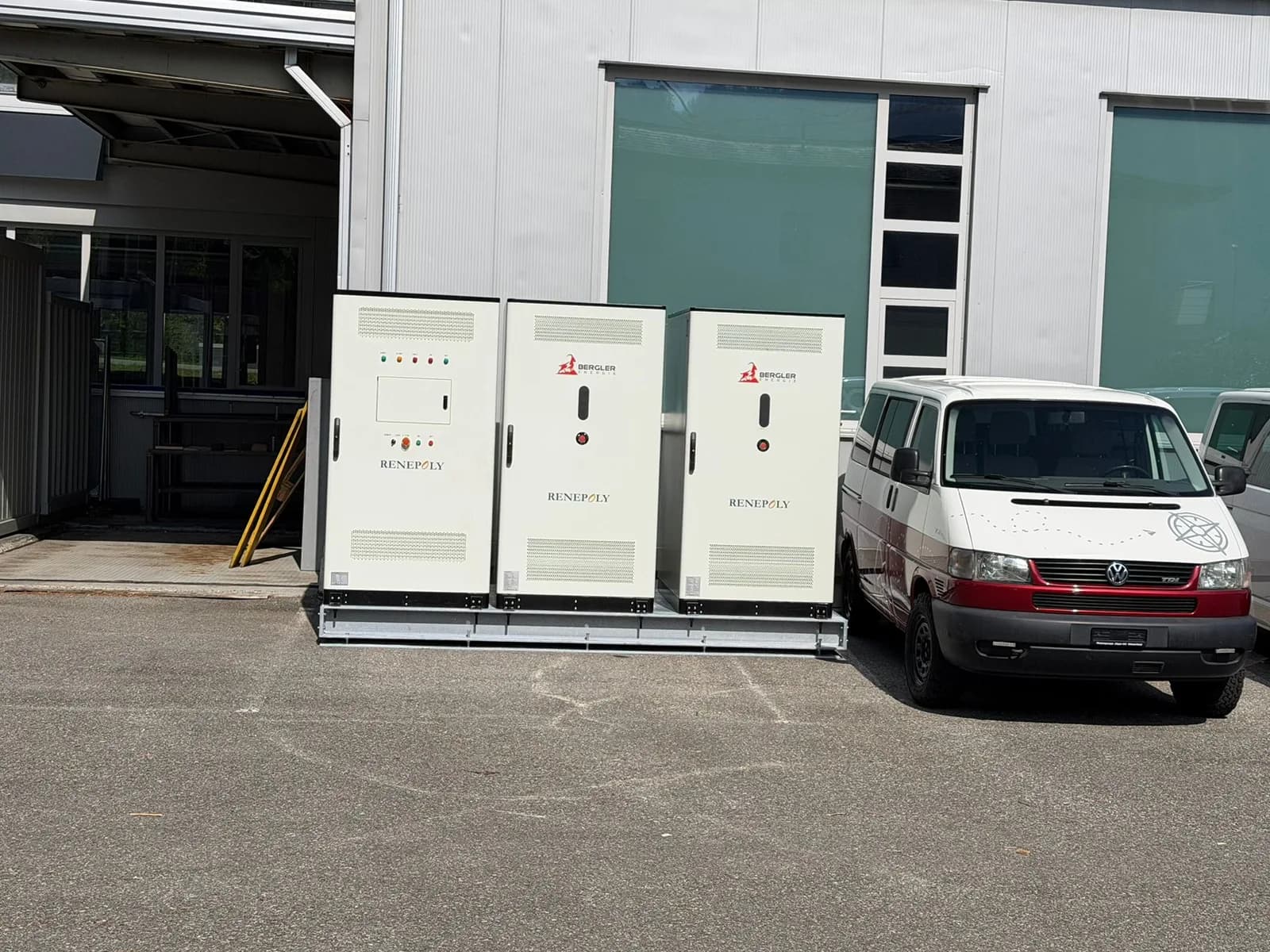
Peak shaving on high demand charges, self-consumption for commercial PV and optional backup for critical systems. We install Renepoly systems, scaled from 120 kWh to over 500 kWh.
- Renepoly EGS/ES series with LFP cells
- Load management for EV charging
- Integration into existing EMS
Large-scale BESS
from 2 MWh
Grid stabilisation, arbitrage, balancing energy marketing and backup for industrial large loads. Renepoly container BESS up to over 5 MWh per unit.
- Container BESS up to 5 MWh+, DC- or AC-coupled
- Pre-qualified for balancing markets
- Combinable with truck charging (720 kW DC)
Prices
What does a battery storage system cost?
Home battery
Including installation and commissioning, depending on capacity, inverter and installation situation.
Commercial & industrial
The online configurator shows your guide price live: in 2 minutes, no obligation.
Häufige Fragen
Battery storage: what you should know
What does a battery storage system cost?
A home battery with 5 – 15 kWh starts at approx. CHF 6,000 including installation, depending on capacity, inverter and installation situation. Commercial and industrial storage is individual: our online configurator shows you a guide price in 2 minutes, no obligation.
Which cell technology does Bergler use?
Exclusively LFP (lithium iron phosphate). This chemistry is thermally stable, fire-safe, cobalt-free and delivers around 6,000 full cycles at 80 % state of health. That is equivalent to 15 – 20 years of typical use.
How big should my home battery be?
Rule of thumb for a single-family home: 1 kWh of storage per 1,000 kWh of yearly consumption. With 5,000 kWh yearly consumption, about 5 – 10 kWh storage. We calculate your individual profile so you don't oversize. Pragmatic and honest.
Is a BESS worth it for my business?
Depends strongly on your demand charge. With high load peaks (typical for industry, workshops, EV charging) peak shaving can reduce energy costs by 15 – 30 %. We run a free analysis based on your load profiles from the past 12 months.
How does a utility-scale BESS become economical?
Revenue streams: balancing energy (primary/secondary/tertiary reserves), day-ahead arbitrage, self-consumption optimisation for industry, peak shaving. We typically structure business cases with 8 – 12 years payback.
What happens after 15 years?
LFP cells slowly lose capacity: after 15 years usually still 70 – 80 % available. The system keeps running. Replacing individual modules usually doesn't make sense, because new and old cells differ in age; the decision typically comes with the end of the battery warranty.
Your energy project still lives in your head?
Tell us about it and we'll get back to you personally. Or call us directly: +41 81 560 20 88. Free initial consultation, transparent quote.
A personal reply on business days, straight from the team.