
Photovoltaics: Commercial
Roof area that generates returns.
Commercial PV from 30 kWp to several MWp. Agriculture, industry, carports and open ground. Typically pays off in 6 – 10 years, thanks to high self-consumption during business hours.
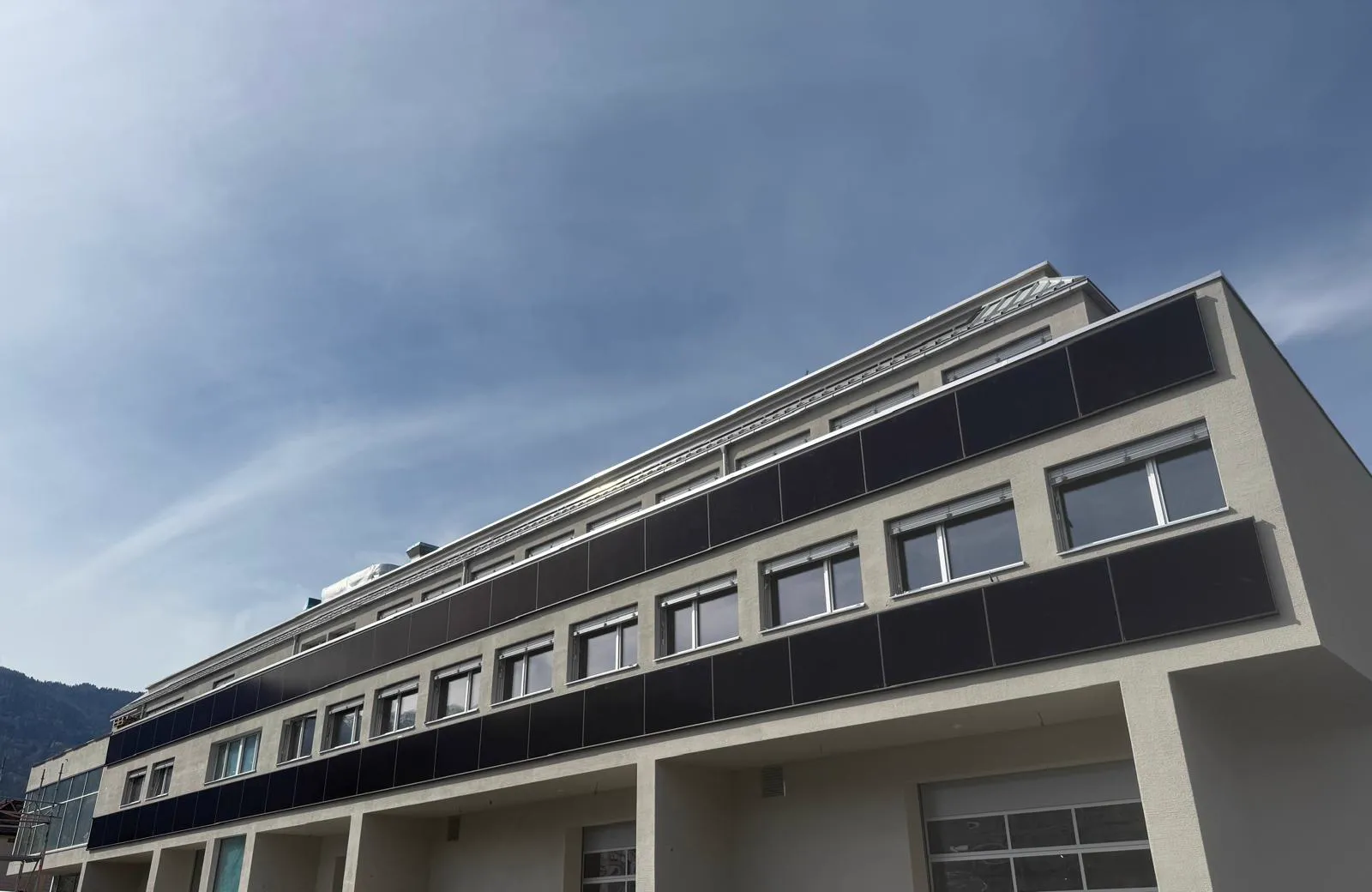
Three segments
Which surface should become a power plant?
We plan, build and operate PV for all three types: from barns to industrial halls, from staff carports to open ground.
Agriculture
50 – 500 kWp
Barn and stable roofs offer large contiguous surfaces. Self-consumption via milking, cooling, drying. The rest goes to the grid or into storage.
- Large spans, few penetrations
- Can be combined with e-tractor charging
- Eternit renovation as part of the PV planning
Industry & commercial
100 kWp – several MWp
Production and logistics halls with high daytime consumption. Self-consumption and peak shaving noticeably lower electricity costs and demand charges.
- Flat and shed roofs, also retrofit
- Load management and EMS integration
- Combination with Renepoly BESS
Carports & open ground
30 kWp – 1 MWp+
Employee parking, customer parking or agricultural open ground. PV carport plus wallboxes becomes ready-made charging infrastructure.
- Solar carport with integrated wallbox
- Load management for e-fleet
- Open ground from 1 ha with elevated mounting
Profitability levers
How a commercial PV pays off
Yield alone doesn't make a commercial PV profitable. These four levers are decisive. We calculate each one individually in every quote.
Self-consumption
Solar power used directly during operating hours, at full purchase price instead of feed-in tariff.
Peak shaving
Cushion load peaks with BESS. Lowers demand charges on industrial tariffs by 15 – 30 %.
PPA models
Power-purchase agreement with a fixed tariff over 10 – 20 years. Predictable energy costs without capital investment.
Storage combo
Renepoly BESS from 120 kWh to 5 MWh. Raise self-consumption to 70 – 90 % depending on your load profile.
So arbeiten wir
From load-profile analysis to commissioning
Potential analysis
We check roof area, structure and your 15-minute load profile from the past 12 months. From that we derive a realistic system size and achievable self-consumption.
Planning & business case
Sizing, inverter topology, optional BESS. We include the payback calculation and check incentive instruments (KLEIV/GREIV) as well as PPA alternatives.
Permitting & grid connection
Building permit, grid connection application with the utility and, if needed, transformer upgrade. We run the conversations and coordinate all trades.
Build, commissioning, operation
Mounting by our team, electrical connection and commissioning. The system can be monitored anytime via the manufacturer portal. Ongoing maintenance and a yield guarantee are not part of the standard scope.
Häufige Fragen
Frequently asked about commercial systems
From when does a commercial PV become economical?
Rule of thumb: the higher your daily consumption and the more constant your load during the day, the faster the system pays off. For a typical commercial operation with 70 – 80 % self-consumption we see 6 – 10 years payback. Production operations running round-the-clock shifts sometimes land below 6 years.
What does a 200 kWp system cost, for example?
Ballpark: CHF 220,000 to CHF 300,000 for hardware and mounting, depending on roof structure and connection situation. With BESS added, the storage cost is on top. The final number depends strongly on civil works, transformer situation and grid connection. We break this down transparently in the quote.
Do you combine PV with battery storage?
Yes, regularly. For commercial and industrial we use Renepoly BESS: from 120 kWh indoor racks to the 5 MWh container. The combined sizing (PV size, BESS capacity, inverter topology) is part of our planning.
Details and model overview: commercial storageWhat is a PPA and who is it suited for?
Power-purchase agreement: we finance, build and operate the system. You only pay a fixed tariff per kWh of solar power, typically below your current purchase price. Suitable for companies that don't want to invest themselves or want to keep their balance sheet clean. Terms 10 – 20 years, after which you can take over the system.
How long does a commercial project take overall?
From contract to commissioning typically 4 – 9 months. The longer lever is usually the grid connection: larger systems need a connection application with the utility, sometimes a transformer upgrade. The mounting itself takes 1 – 6 weeks depending on size.
What incentives are available for commercial PV?
One-off remuneration (EIV) from the federal level for all systems. It becomes significant for systems above 100 kWp. Cantonal incentive programmes depending on location. Tax: accelerated depreciation and income/profit tax deduction. We handle the incentive applications as part of the project.
Your energy project still lives in your head?
Tell us about it and we'll get back to you personally. Or call us directly: +41 81 560 20 88. Free initial consultation, transparent quote.
A personal reply on business days, straight from the team.